Top: World's first 360-degree Panorama of Ushguli, Svaneti, Georgia, Feb 24/2009, from 12 separate photos...

Saturday, 13 October 2007

Ipari, Svaneti, August 2007

This village is roughly halfway between Mestia and Ushguli. I suspect it doesn't get enough stops, is more of a place to pass through between the other two points. But Jeff and I stopped here on our June walk up - and lost the horse - and camped above it on our way back - and nearly lost the horse again. So it has some pretty special memories. There is also a beautiful old church with an exquisite chased gold icon and some wild frescoes, all of St George.

The long house at far left in the top shot belongs to the village's gamgebeli, or governor. Here is where we stayed on the way up in June.

Here I pause to say: Happy Birthday dear A! I'll be trying to call you a little later in the day. Hope you have a great day. Wow, a year has passed since G & I were able to be there for the last one. Is it stinking hot there yet? We're slipping mildly into fall, but it's still warm enough in Tbilisi to contemplate outdoor swimming.
Lots of love,
Me

National Manuscript Centre, Tbilisi, September 2007

Three from the same book, a Bible, in Old Georgian. The top two show parts of its cover.


Kvirikoba, July 28, 2007 (top to bottom)

Top: here's what a successful lifting of the Big Rock looks like.

Bottom: general view of the festival and some of the 30 people with whom I travelled to Svaneti this time.

Thursday, 11 October 2007

Salt for Svaneti[a], Part I (silent film)

Parts II & III & details below.

A hint for watching these rather long videos (c. 17 minutes each): let each chapter buffer or load for a while (half or more) before starting to watch it, then it can run without stopping to load the rest.

Salt for Svaneti[a], Part II (silent film)

Part I above, Part III and details below.

Salt for Svaneti[a], Part III (silent film)

Parts I & II above.

I found this gem from 1930, filmed by Mikheil Kalatozov, in the USA on VHS; friends brought it here to Georgia for me. Had it transferred to DVD here. The VHS copy states that only the sound, which is a modern addition to what was originally a silent film, is copyright. So I have removed the sound and am making this nearly hour-long film available to watch in 3 parts on the blog. It's from Ushguli, Europe's highest village; Svan friends of mine say that its depiction of Svan culture as it was then is quite accurate. There's a strong communist propaganda element to the film, of course, as should be expected from a film of its time period. And it's obviously an early film as far as genre goes - how much is documentary, how much drama? The baby death must be staged, along with the avalanche scenes; the horse's death may not be. The funeral itself is likely real, and the terrible July blizzard is a fact, remembered by people I knew.

This is the village to which I will be moving in November 2007 to teach English, learn Svan and really start investigating the Svan people's culture. So, enjoy the first film of Ushguli. (Each part is about 75 MB in size, at least as I uploaded it... some patience may be needed.)

Wednesday, 10 October 2007

Ushguli, August 2007

Bottom - the second-highest church of the village, a tiny but beautiful chapel.

Top two - more of the highest church from the same time as the previous (bottom) shot.


National Manuscript Centre, Tbilisi, September 2007

This is, of course, Hebrew, from one of the Centre's many beautiful scrolls.

Kvirikoba, Svaneti, July 28, 2007 (top to bottom)

Three from the Kvirikoba festval in K'ala, the first time I was there.

Top - part of the long, steep walk from the road up to the church itself. Even elderly people, though, were making the trip.

Middle - the crowd planting candles on the church walls and having their prayers read out, while the bell-ringer did his thing & shouted, "Hamin!" (Amen)

Bottom - one of the event's feats of strength, the lifting of a large rock which is not only heavy but quite unwieldy into the bargain. Popular with the young toughs showing off. Out of my league for both size and mass; and to whom would I strut my stuff anyway?

Tuesday, 9 October 2007

Ushguli, August 2007

Mt Shkhara... Lamaria Church... and, above, a church bell.


National Manuscript Centre, Tbilisi, September 2007

(Video uploading having been a failure tonight despite multiple attempts, I'm abandoning it until tomorrow. Sorry.)

More of the Mongolian book, including another page spread and the complete rope-bound manuscript. Date unknown.


Monday, 8 October 2007

Ushguli, August 2007

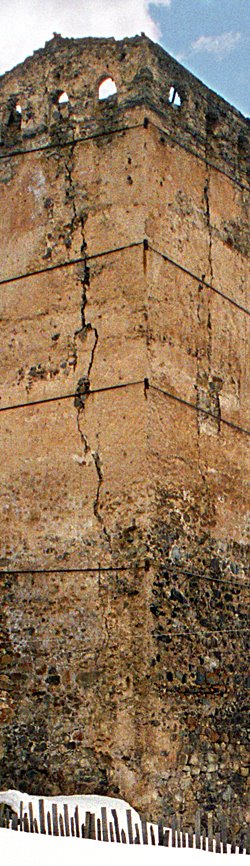
My American guest and I were walking through the village from top to bottom when, at the top of the bottom hamlet, we were asked by a young fellow if we'd like to climb up inside a watchtower.

I treat every such experience as a new adventure in photography, because the tower's small windows and thick walls give only narrow glimpses of the world outside. (Best to use as wide a lens as you have.) Thus every view from a watchtower is unique and treasured for me.

This week I have noticed the first viewer from each of three new countries - Qatar, South Africa and - today - Slovakia, the 54th country. Welcome! I also note that only now, after nearly 7 months of the blog's existence, is the USA - with a population some 70 times that of Georgia - catching up in viewer numbers to the latter.


In and above Ushguli, July 2007

Oops - should've uploaded the videos before the manuscript shot! Oh well, never mind.

Top - I shot this 360-degree video panorama in rather a hurry, as the first one I tried, from the top of Mt Lamaria, failed to film after about 5 seconds. So, apologies for the whirlwind tour, which is from near the pass above Ushguli from which the Lentekhi side of Svaneti is visible. It starts and ends with what you can see of Ushguli at the bottom of the frame.

Bottom - candle making. This, using beeswax and cotton, is the traditional Georgian way. The next day some of us took the candles and set off by foot for K'ala, 10 km lower, for the Kvirikoba festival there. More footage to follow.

National Manuscript Centre, Tbilisi, September 2007

This was from an amazing Mongolian book, rope-bound, handwritten in the vertical script. Date unknown. (In case anyone's wondering, I was keeping a shallow focus in all my photographs at the NMC, not trying to get it all in focus but rather to zero in on something within each image.)

Sunday, 7 October 2007

Ushguli, August 2007

Two more locations I'll likely return to frequently for differing light and weather. The top one, though (Lamaria Church), is my best shot so far of this scene.


National Manuscript Centre, Tbilisi, September 2007

Two more images, the top one a closeup from the bottom, from the K'ala book, Georgian, 11th Century.


Football, Ushguli, July 2007

Us vs. them, i.e. guests vs. locals. 2 clips from opposite ends of the field, which is at the top of the village; a goal by each side. We (guests) won.

Saturday, 6 October 2007

Ushguli, August 2007

A couple of views from the village's main museum windows. Generally one is not allowed to photograph inside, but such angles are permitted.

At the bottom of the top frame is Ushguli school again.


National Manuscript Centre, Tbilisi, September 2007

(For the next while my photographs will be from both this location and Svaneti, one or several of each daily. Today - something from K'ala, Svaneti, 11th Century, written in the original of Georgia's three alphabets.)

Into a cold, rather dark room, pleasant change from the 35-degree heat of Tbilisi in late summer. Row upon row of metal shelves containing treasures of literature in many different languages. I had stumbled across the National Manuscript Centre (see http://manuscript.ge/?ln=eng ) helping a new friend from the USA who was working on his doctoral thesis in connection with early Georgian printing. But here were hundreds of books almost all written by hand.

The centre's director, as it turns out, is an avid photographer like me. He was ready with postcard gifts based on his work, and is a good PR man for the Centre as well. His current idea is an exhibition of photographs from the Centre's archives - and I was the first foreigner he invited to participate.

My setup was extremely simple: tripod, no flash - God forbid any extra light on these ancient, delicately magnificent pages of text and illumination! Either a simple 50mm standard lens, or this with a macro-focusing 2x converter added to the camera body. I was shooting quite close most of the time, zeroing in on small details of script, art or binding. There was much to choose from, brought to me either by my request ("Er, do you have anything from Svaneti?" "12th century, K'ala village...") or their expert choice ("Mongolian, we don't actually know how old it is... Amharic from Ethiopia - well-preserved for a 10th-century book, don't you think?"). Dazzled, I spent two days there, and in the end covered these languages plus Armenian (one selection was written on a grape leaf), Hebrew, Gothic (not just the alphabet but the long-dead language), Latin, Slavonic, Persian, Turkish, and Arabic (the most beautiful book I have ever seen, a hand-painted Quran resembling a miniature carpet). I touched nothing: the archive worker's gloved hands brought, opened, arranged on a piece of white paper which I was able to turn to my liking.

Whe photographing art, a useful control to have along is a colour bar - a strip of paper on which are printed, as permanently as posible, a set of standard printing colours and shades of grey. You place this next to the art and photograph them together, then compare the output - whether instant digital photo or scan - with the original colour bar, to ensure that tones and colours are reproduced accurately. I hadn't even thought to take a colour bar with me, but even if I had, it might have proved a real challenge to use in the tight closeups I was shooting. Nonetheless, several control shots with such a thing in the tungsten lighting, showing up a strong yellow colour cast on film, would have proved useful. As it is I've had to gradually build towards correct colours in my scanned shots on the computer, putting them aside and returning to them in stages. Many of the pages were somewhat yellowed with age - how much of my yellow cast was tungsten light, and how much was old paper? Gold book covers or gold leaf on the pages of the painted Quran must come across clearly as shiny metallic gold. Gently, gently, step by step towards a realistic presentation. Keep all photographs in a set from the same manuscript in the same colour range. Return later to the Centre to consult with its staff on final colour adjustments.

A good assignment for a photographer who is also a serious lover of books. Here is a selection from the scanned work. Exhibition details in Tbilisi to be announced...

Ushguli, July 2007 (top to bottom)

The videos from the Svaneti walk are over... but I still have many more clips from later trips and other locations. Here are three to begin a new series from the crazy trip of July '07 - 3 vanloads of Georgians and I, 27 hours instead of 14 to reach Ushguli, a week staying there, a couple of TV interviews.

Top - our 240-litre wine barrel being unloaded in Ushguli. It took 2 hours in Zestaponi en route to arrange the acquisition of this little gem. Couldn't be bought before we left Tbilisi! Oh no!

Bottom 2 - a new friend helps out an elderly local lady with the hay.