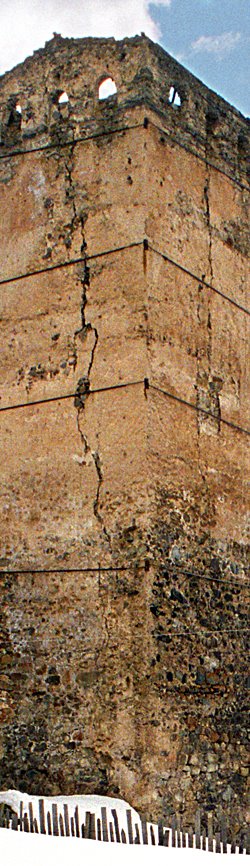
Top: World's first 360-degree Panorama of Ushguli, Svaneti, Georgia, Feb 24/2009, from 12 separate photos...
Showing posts with label fractal. Show all posts

Saturday, 7 February 2009

Textures, Ushguli, Svaneti, Georgia


I was given a copy of Zen and the Art of Motorcycle Maintenance by a friend for Christmas 1992.  It has joined my shortlist of "books to reread for the rest of my life", though I wouldn't say that I agree with all of Mr. Pirsig's conclusions.  One of the exercises he describes giving his  writing students was to detail a wall, starting off with one single brick.  They left the class looking at him with pity or horror as one might a madman, but came back to the next lesson with wonder in their eyes - and torrents of prose on their pages, unstoppable.

Today's images are my own version of this process of looking at details and hardly knowing where to stop once you start.  Not that anything was a great surprise for me as I rediscovered cracked paint and fantascically chaotic rusted sheet metal and window frost in Ushguli, but the delight was new as it is every time.  It is heightened by my having read enough on chaos in natural processes - like the young hero of The Sixth Sense who finally blurts out his terrible secret, "I see dead people", I don't go around (or didn't until now) telling everyone that "I see structure everywhere I look...". Chaos reading, and fractal exploration, have done this to my vision.  I wouldn't change it for the world.  Every tree, cloud, old painted or rotted or rusted surface pulls me in to stare at its patterns, and to try to photograph them if I have the camera with me.  So yes, maybe I'm a bit mad, but typical of such people I'm quite at home in my condition, and even think that others need to see things this way too.  Another thing it does for me is, it convnces me that God IS a geometer; but His geometry is fractal, not simple lines and smooth curves.


Tuesday, 4 September 2007

Another Fractal Day...

The Dragon Curve and TwinDragon

Take a long thin ribbon of paper and fold it in half, making it half as long. Keep on doing this in the same direction until it's too thick to fold. Then open it out and make every fold 90 degrees. The resulting shape is called the Dragon Curve for its form (see the bottom 3 images). It's a simple fractal with every section identical except for scale. But it's also a tile, meaning that copies of it can be scattered across the space of its dimension with no overlaps or spaces in between. Moreover, it can tile in 2 ways: in a pinwheel of 4, or in 2 laid "nose to tail". This latter shape is then called the TwinDragon, a tile in its own right (see the top 4 images). Made in CorelDraw, jazzed up in PhotoShop.


Sunday, 13 May 2007

Fractal Day 2 - but only a couple; other work below them.

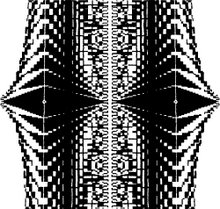
Miscellaneous fractals of mine which didn't fit into any other categories - the first an IFS variation, the second a space-operatic Lyapunov type.
Made in Fractint.


Tuesday, 1 May 2007


The posts start at the top and go down in this section.

It's Fractal Day 1 on the blog!

(Oh noooooo, he's discovered fractals...
Wot's a fractal?
From the Latin fractus, meaning broken, coined by the champion of the science, Benoit B Mandelbrot in 1975. Forms - in nature and mathematics - which display self-similarity on many scales. The best examples in nature are clouds. But fractals also occur in many other places, such as the human body's maximally packed venous, arterial and respiratory systems, and anyplace where branching forms are called for. The most widely explored example in mathematics is the Mandelbrot Set, pieces of which have been rendered on computers such that if the entire Set were at such a scale, it would be larger than the entire universe. Literally.
The seminal book on the subject has to be Mandelbrot's own The Fractal Geometry of Nature, which has had several editions.
Oh.)

I was delving into fractals in the mid-1980s: instantly fascinated with their forms (lavishly illustrated in the scientific literature), which must have spoken to my personality as an artist. Fractals are nature's structures. My own simplest definition of the word fractal is "made of itself". Mathematical fractals have the addictive quality of being calculable as large as your computing power and patience allows. I will describe several types on these pages, with some examples. And someday maybe I'll get to photographing some real-world ones as well...

(Now is perhaps a good time to point out that ALL of the pictures I post in the main part of my blog will reopen in a larger size (usually 1000 pixels on the long side) when you click on them once. They can then be saved to your computer as wallpaper or whatever. Enjoy.)

The aforementioned Mandelbrot Set, most famous fractal of them all, calculated from z->z^2+c on the complex plane. Enough of formulae: enjoy the pretty pictures. The complete critter in white (top), and 2 small details of the infinity to be found along its border (below). Made in Fractint.


Iterated Function Systems (IFS)

Another type of fractal. Some finds of mine: these are fractals which fill a square (Brazil and Fractint).