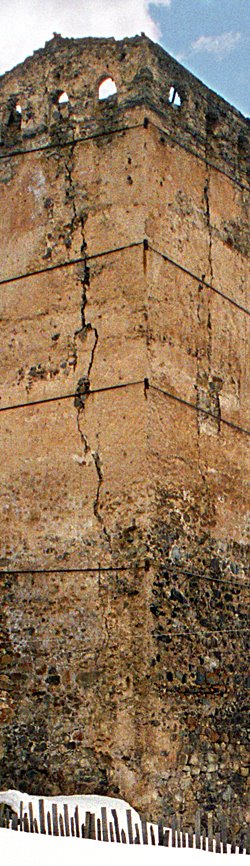
Top: World's first 360-degree Panorama of Ushguli, Svaneti, Georgia, Feb 24/2009, from 12 separate photos...
Showing posts with label National Manuscript Centre. Show all posts

Thursday, 8 November 2007

National Manuscript Centre, Tbilisi, September 2007

Top, part of an imperial Ottoman firman (I think that;s the right word), in Arabic.

Bottom, another from the Persian book.

This concludes my series on these beautiful ancient hand-written and -illustrated works of art in many different languages.


Wednesday, 7 November 2007

National Manuscript Centre, Tbilisi, September 2007

Two from a marvellous Persian book with painted miniatures.


Tuesday, 6 November 2007

National Manuscript Centre, Tbilisi, September 2007

I remember asking specifically for something either in Old Church Slavonic (the parent language of all the Slavic languages, still in use in the Russian Orthodox Church) or in Russian, to include in my photographs for the Centre. This, in the former language, was what they let me see. The set of parallel red bars in both frames is also writing.


Friday, 26 October 2007

National Manuscript Centre, Tbilisi, September 2007

Today, two dead tongues.

Above, Latin.

Below, ever seen Gothic before? Not the fashion statement or the philospohy or the literary genre, but the long-dead language? Well, now you can say that you have. As usual from this Centre, handwritten.

Thursday, 25 October 2007

National Manuscript Centre, Tbilisi, September 2007

Two more from the beautiful Armenian Bible of yesterday's posts.


Wednesday, 24 October 2007

National Manuscript Centre, Tbilisi, September 2007

A lovely handwritten, hand-illuminated Armenian Bible. More to come.


Tuesday, 23 October 2007

National Manuscript Centre, Tbilisi, September 2007

Bottom, Amharic from Ethiopia, the oldest manuscript I saw, from the 10th century.

Top, Armenian, written on a grape leaf, date unknown.


Monday, 22 October 2007

National Manuscript Centre, Tbilisi, September 2007

A final two from the illuminated Quran, before moving on to other manuscripts and languages.


Saturday, 20 October 2007

National Manuscript Centre, Tbilisi, September 2007

More pages from that magnificent Quran, all hand-illuminated.

Thursday, 18 October 2007

National Manuscript Centre, Tbilisi, September, 2007

And now - for the next few day's posts from the NMC - we come to the most beautiful thing I saw there: a Quran, in Arabic, of course. I must find out what century this exquisite hand-painted book is from, its pages each a work of art more resembling a Persian carpet than something merely to read.


Wednesday, 17 October 2007

National Manuscript Centre, Tbilisi, September 2007

(Yesterday I could get no further than uploading the video clip from Ushguli. Today's 2 sets of photos finish that upload.)

Details of two more chased metal covers for ancient Bibles.


Monday, 15 October 2007

National Manuscript Centre, Tbilisi, September 2007

More from an ancient Georgian Bible.

Bottom, Jesus, Mary and John the Baptist.

Top, Jesus being tempted by Satan after his 40-day wilderness fast.


Sunday, 14 October 2007

National Manuscript Centre, Tbilisi, September 2007

These two frames are of my single favourite item of all that I saw: the clasps of yesterday's Georgian Bible. One frame straight on, one showing things at an angle with shallow focus or depth of field.


Saturday, 13 October 2007

National Manuscript Centre, Tbilisi, September 2007

Three from the same book, a Bible, in Old Georgian. The top two show parts of its cover.


Wednesday, 10 October 2007

National Manuscript Centre, Tbilisi, September 2007

This is, of course, Hebrew, from one of the Centre's many beautiful scrolls.

Tuesday, 9 October 2007

National Manuscript Centre, Tbilisi, September 2007

(Video uploading having been a failure tonight despite multiple attempts, I'm abandoning it until tomorrow. Sorry.)

More of the Mongolian book, including another page spread and the complete rope-bound manuscript. Date unknown.


Monday, 8 October 2007

National Manuscript Centre, Tbilisi, September 2007

This was from an amazing Mongolian book, rope-bound, handwritten in the vertical script. Date unknown. (In case anyone's wondering, I was keeping a shallow focus in all my photographs at the NMC, not trying to get it all in focus but rather to zero in on something within each image.)

Sunday, 7 October 2007

National Manuscript Centre, Tbilisi, September 2007

Two more images, the top one a closeup from the bottom, from the K'ala book, Georgian, 11th Century.


Saturday, 6 October 2007

National Manuscript Centre, Tbilisi, September 2007

(For the next while my photographs will be from both this location and Svaneti, one or several of each daily. Today - something from K'ala, Svaneti, 11th Century, written in the original of Georgia's three alphabets.)

Into a cold, rather dark room, pleasant change from the 35-degree heat of Tbilisi in late summer. Row upon row of metal shelves containing treasures of literature in many different languages. I had stumbled across the National Manuscript Centre (see http://manuscript.ge/?ln=eng ) helping a new friend from the USA who was working on his doctoral thesis in connection with early Georgian printing. But here were hundreds of books almost all written by hand.

The centre's director, as it turns out, is an avid photographer like me. He was ready with postcard gifts based on his work, and is a good PR man for the Centre as well. His current idea is an exhibition of photographs from the Centre's archives - and I was the first foreigner he invited to participate.

My setup was extremely simple: tripod, no flash - God forbid any extra light on these ancient, delicately magnificent pages of text and illumination! Either a simple 50mm standard lens, or this with a macro-focusing 2x converter added to the camera body. I was shooting quite close most of the time, zeroing in on small details of script, art or binding. There was much to choose from, brought to me either by my request ("Er, do you have anything from Svaneti?" "12th century, K'ala village...") or their expert choice ("Mongolian, we don't actually know how old it is... Amharic from Ethiopia - well-preserved for a 10th-century book, don't you think?"). Dazzled, I spent two days there, and in the end covered these languages plus Armenian (one selection was written on a grape leaf), Hebrew, Gothic (not just the alphabet but the long-dead language), Latin, Slavonic, Persian, Turkish, and Arabic (the most beautiful book I have ever seen, a hand-painted Quran resembling a miniature carpet). I touched nothing: the archive worker's gloved hands brought, opened, arranged on a piece of white paper which I was able to turn to my liking.

Whe photographing art, a useful control to have along is a colour bar - a strip of paper on which are printed, as permanently as posible, a set of standard printing colours and shades of grey. You place this next to the art and photograph them together, then compare the output - whether instant digital photo or scan - with the original colour bar, to ensure that tones and colours are reproduced accurately. I hadn't even thought to take a colour bar with me, but even if I had, it might have proved a real challenge to use in the tight closeups I was shooting. Nonetheless, several control shots with such a thing in the tungsten lighting, showing up a strong yellow colour cast on film, would have proved useful. As it is I've had to gradually build towards correct colours in my scanned shots on the computer, putting them aside and returning to them in stages. Many of the pages were somewhat yellowed with age - how much of my yellow cast was tungsten light, and how much was old paper? Gold book covers or gold leaf on the pages of the painted Quran must come across clearly as shiny metallic gold. Gently, gently, step by step towards a realistic presentation. Keep all photographs in a set from the same manuscript in the same colour range. Return later to the Centre to consult with its staff on final colour adjustments.

A good assignment for a photographer who is also a serious lover of books. Here is a selection from the scanned work. Exhibition details in Tbilisi to be announced...